
Seamless Splicing Indoor LED Panels vs. LCD Video Walls: An Expert Guide to Commercial Display Solutions
In the dynamic landscape of modern commercial environments, visual communication is paramount. Businesses across retail, corporate, entertainment, and public sectors are constantly seeking display technologies that can capture attention, convey critical information, and enhance brand experiences. The choice often narrows down to two dominant contenders: Seamless Splicing Indoor LED Panels and LCD Video Walls. While both offer large-format visual solutions, their underlying technologies, performance characteristics, and suitability for various applications differ significantly. As a leader in Indoor Commercial LED solutions, we delve into an authoritative comparison to help you make an informed decision that aligns with your strategic objectives.
This comprehensive guide will dissect the nuances of each technology, examining critical factors such as visual performance, scalability, total cost of ownership (TCO), and operational longevity. Understanding these distinctions is crucial for deploying a display solution that not only meets immediate needs but also provides long-term value and impact.
Understanding the Technologies: LED vs. LCD Foundations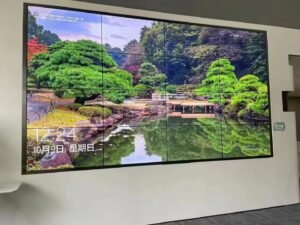
LCD Video Walls: A Closer Look
LCD (Liquid Crystal Display) video walls are constructed by tiling multiple individual LCD monitors together to form a single, larger display surface. Each panel operates independently, driven by its own backlight unit. While significant advancements have been made in reducing the bezel (frame) around each panel, a fundamental characteristic of LCD video walls remains the visible gaps between individual screens. These gaps, even when ultra-narrow, interrupt the continuity of the displayed image, creating a “grid” effect.
Strengths:
- Cost-Effectiveness: Generally have a lower initial purchase price per square meter compared to LED.
- High Resolution per Panel: Individual LCD panels often offer high native resolutions (e.g., 1080p or 4K), which can be beneficial for specific close-up viewing applications.
- Established Technology: Widely understood and easier to source and integrate for standard setups.
Weaknesses:
- Visible Bezels: The most significant drawback, creating distracting lines that segment content.
- Brightness Limitations: Typically less bright than LED, struggling in environments with high ambient light.
- Color and Brightness Uniformity: Can be challenging to maintain consistent color and brightness across an entire wall due to variations between individual panels and backlight degradation.
- “Mura” Effect & Burn-in: Susceptible to temporary or permanent image retention (burn-in) with static content.
Seamless Splicing Indoor LED Panels: The Direct View Revolution
Seamless Splicing Indoor LED Panels, also known as Direct View LED (DV LED), represent a fundamentally different approach. Instead of backlighting liquid crystals, these displays use an array of tiny LEDs (Light Emitting Diodes) to directly emit light and form pixels. These panels are modular, allowing them to be seamlessly tiled together to create displays of virtually any size and shape, without any visible lines or gaps.
The innovation of Narrow Pixel Pitch (NPP) LED has further blurred the lines between LED and LCD, making LED viable for closer viewing distances where pixel density is critical. Our Indoor Commercial LED solutions exemplify this progress, offering superb visual clarity and true seamlessness.
Strengths:
- True Seamlessness: Absolutely no bezels or visible gaps, providing a single, continuous canvas.
- Superior Brightness and Contrast: Offers significantly higher brightness and deeper blacks, leading to unparalleled contrast ratios and vibrant visuals even in brightly lit spaces.
- Wider Viewing Angles: Consistent image quality and color from extreme angles.
- Unmatched Scalability and Flexibility: Can be built to almost any size or unconventional shape, offering creative design freedom.
- Long Lifespan and Reliability: Individual LED diodes have a long operational life, and modular design allows for easier maintenance.
Weaknesses:
- Higher Initial Investment: Generally comes with a higher upfront cost compared to LCD video walls.
- Power Consumption: Can be higher, particularly for larger, very bright displays, though advancements like common cathode technology are improving efficiency.
- Installation Complexity: Requires skilled technicians for precise installation and calibration to ensure perfect panel alignment.
The Critical Differentiator: Seamlessness and Visual Integrity
The Bezel Barrier: LCD’s Inherent Limitation
The most glaring difference, and often the primary deal-breaker for many high-impact applications, is the issue of seamlessness. LCD video walls, regardless of how thin their bezels become, will always present a grid of lines across the content. These lines act as visual interruptions, dissecting images, text, and graphics. For applications where a coherent, immersive visual experience is paramount – such as branding walls, artistic installations, control room dashboards, or detailed data visualization – these bezels are not merely an aesthetic imperfection but a functional impediment. They disrupt flow, reduce readability, and diminish the overall impact of the displayed content.
Uninterrupted Canvas: The LED Advantage
In stark contrast, Seamless Splicing Indoor LED Panels offer an absolutely uninterrupted visual canvas. The modular nature of LED panels allows them to be precisely aligned, creating a single, monolithic display surface where individual panel edges are invisible to the naked eye. This true seamlessness is transformative:
- Enhanced Immersion: Content flows naturally, pulling viewers into the experience without distraction.
- Superior Branding: Brand logos, advertisements, and corporate messages are presented with utmost clarity and impact.
- Critical Data Display: In environments like control rooms or broadcast studios, where every pixel conveys crucial information, seamlessness ensures no data is obscured or misinterpreted.
- Artistic Freedom: Enables creative installations that bend, curve, or integrate into architectural features in ways impossible with LCD.
Visual Performance Metrics: Brightness, Contrast, and Color Fidelity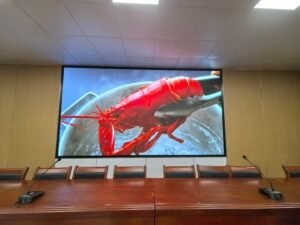
Brightness and Contrast: Dominance of LED
When it comes to raw luminosity and the ability to display deep, rich images, Indoor LED Panels unequivocally outperform LCD video walls. LED technology offers significantly higher brightness levels (often measured in nits), making content highly visible and impactful even in environments with strong ambient lighting, such as sunlit lobbies or brightly lit retail spaces. This superior brightness is coupled with an exceptional contrast ratio, as each LED pixel can be individually dimmed or turned off, achieving true blacks and creating a dramatic visual depth that LCD struggles to match with its backlit architecture.
LCD video walls, while capable of decent brightness, are fundamentally limited by their backlights. This limitation means blacks appear more as dark grey, and bright areas can appear washed out under direct light, reducing overall visual punch and clarity.
Color Reproduction and Uniformity
LED displays boast a wider color gamut and remarkable color consistency across the entire screen. Each LED emits light directly, ensuring that colors are vibrant, accurate, and uniform from one module to the next. Advanced calibration techniques further guarantee perfect color balance across vast LED surfaces. This is critical for brand identity and high-fidelity content display.
LCD video walls, conversely, often face challenges with color uniformity. Slight variations in backlighting, panel manufacturing, and aging can lead to noticeable color shifts between adjacent panels, creating a patchwork effect that detracts from the overall visual quality. While sophisticated calibration tools can mitigate this, achieving perfect uniformity across a large LCD wall remains a persistent hurdle.
Viewing Angles: Accessibility for All
Indoor LED Panels are renowned for their exceptionally wide viewing angles. Content remains clear, bright, and color-accurate even when viewed from extreme off-axis positions. This is vital in spaces with large audiences or where viewers are likely to be moving around, ensuring everyone gets a consistent, high-quality visual experience.
LCD technology, while improved, still exhibits some degree of color shift, brightness degradation, or contrast loss when viewed from sharp angles. This can limit the effective viewing area and diminish the impact for audiences not positioned directly in front of the screen.
Scalability, Flexibility, and Installation Dynamics
Customization and Size Freedom
One of the most compelling advantages of Indoor LED Panels is their unparalleled scalability and design flexibility. Because they are built from modular units, LED displays can be assembled into virtually any size or aspect ratio imaginable. From vast, building-spanning screens to intricately curved or uniquely shaped artistic installations, LED offers creative freedom that simply isn’t possible with fixed-panel LCDs. This makes LED ideal for bespoke architectural integration and truly unique visual experiences.
LCD video walls are confined to rectangular arrays of standard panel sizes. While they can be scaled in size by adding more panels, the fundamental shape and the presence of bezels limit creative design possibilities significantly.
Installation and Maintenance Considerations
The installation of a Seamless Splicing Indoor LED Panel system is a precise, technical process. It requires expert planning, structural integrity assessments, and highly skilled technicians to ensure perfect alignment of thousands of individual diodes. However, modern LED panels are designed for modularity and front/rear serviceability, meaning individual modules can often be hot-swapped for maintenance or repair without dismantling the entire wall.
LCD video wall installation can be comparatively simpler for standard configurations, but replacing a single faulty panel within a large grid can still be a disruptive process. Calibration and alignment between panels are also ongoing considerations for LCDs.
Long-Term Ownership: Lifespan, Power, and Maintenance
Durability and Lifespan
Indoor LED Panels typically boast a longer operational lifespan, often rated at 100,000 hours or more to 50% brightness. This translates to over a decade of continuous operation, making them a robust long-term investment. The individual diodes are durable, and modular design allows for targeted repairs, extending the overall life of the display.
LCD video walls generally have a shorter lifespan, with backlights beginning to degrade after 50,000-60,000 hours, which can lead to reduced brightness and color uniformity issues over time. Replacing an entire LCD panel is often the only solution for significant failures, incurring higher costs and downtime.
Energy Consumption and Heat Management
Historically, LED displays were perceived as more power-hungry. However, advancements in LED technology, such as common cathode designs and more efficient LED chipsets, have significantly improved energy efficiency. While a very large, high-brightness LED wall can still consume more power than a comparable LCD wall, the gap is narrowing, and the power consumption is often offset by superior performance and longer lifespan.
LCD video walls typically have more predictable power consumption, often lower for smaller, less bright installations. Both technologies require adequate heat management, but LED’s direct emission can sometimes generate more localized heat, necessitating proper ventilation.
Maintenance and Total Cost of Ownership (TCO)
While the initial investment for Indoor LED Panels may be higher, their modular design simplifies maintenance. Individual modules or power supplies can often be quickly replaced, minimizing downtime and technician visits. This leads to a more predictable and often lower long-term maintenance cost. When factoring in the longer lifespan, superior visual impact, and reduced replacement cycles, the Total Cost of Ownership (TCO) for LED can often be more favorable for high-usage, mission-critical, or high-impact applications.
For LCD video walls, while individual panel replacement might be less frequent, the cost per panel can be significant, and the entire wall may need recalibration after replacement. The ongoing need for color uniformity adjustments and the shorter overall lifespan contribute to their TCO.
Application Suitability: Choosing the Right Technology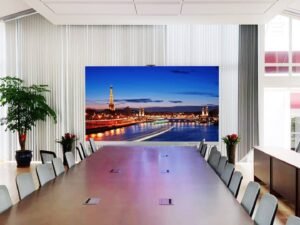
Where LCD Video Walls Excel
- Budget-Sensitive Projects: For organizations with tighter budgets where the highest level of visual seamlessness isn’t a critical requirement.
- Smaller Displays & Shorter Viewing Distances: Where the individual panel resolution is more important than overall seamlessness, and viewers are very close.
- Static or Less Dynamic Content: If the primary use is displaying relatively static information or less demanding graphics where bezels are acceptable.
- Office Meeting Rooms: For standard video conferencing or presentations where ultra-premium visuals aren’t the top priority.
Where Indoor LED Panels are Indispensable
For applications demanding unparalleled visual impact, true seamlessness, and long-term reliability, our Indoor Commercial LED solutions are the definitive choice:
- High-Impact Retail & Brand Flagships: To create immersive brand experiences and captivating advertising displays.
- Control Rooms & Command Centers: Where critical data must be displayed across a single, uninterrupted canvas without visual segmentation.
- Broadcast Studios & Virtual Sets: For flawless backgrounds and dynamic content without flicker or seams.
- Auditoriums & Performing Arts Venues: Providing stunning backdrops and live content with exceptional brightness and clarity.
- Corporate Lobbies & Experiential Spaces: For creating grand, welcoming, and informative digital art or messaging installations.
- Transportation Hubs & Public Information Displays: Ensuring maximum readability and visibility in high-traffic, brightly lit environments.
- Luxury Showrooms & Automotive Retail: To showcase products with vibrant, true-to-life color and dynamic content.
The Future of Indoor Commercial Displays
Advancements in LED Technology
The trajectory of Indoor LED Panels continues to accelerate. Innovations like Mini-LED and Micro-LED are pushing pixel pitches to astonishingly small sizes, making LED viable for even closer viewing distances with incredible detail. Further refinements in common cathode technology, Chip-on-Board (COB) packaging, and integrated processing are leading to even greater energy efficiency, higher reliability, and easier installation methods. The modular nature of LED also positions it perfectly for integration with emerging technologies like interactive surfaces and augmented reality.
Sustained Role for LCD
Despite LED’s rapid ascendancy, LCD video walls will continue to hold a niche, particularly in cost-sensitive applications where their limitations are acceptable, or where very high native resolution per panel for extremely close viewing is prioritized over seamlessness.
Conclusion: Making an Informed Decision for Your Business
The choice between Seamless Splicing Indoor LED Panels and LCD Video Walls is not merely a technical one; it’s a strategic business decision that impacts brand perception, operational efficiency, and long-term investment value. While LCD video walls offer a lower initial cost and good individual panel resolution, their inherent bezel limitations, brightness constraints, and potential for color uniformity issues often fall short of the demands of modern, high-impact commercial environments.
For businesses seeking truly immersive, visually stunning, and future-proof display solutions that deliver exceptional brightness, contrast, color fidelity, and limitless scalability without interruption, Indoor LED Panels are the superior choice. They represent an investment in a seamless visual experience that captivates audiences, reinforces brand identity, and provides unparalleled flexibility for creative expression.
We invite you to explore our comprehensive range of Indoor Commercial LED solutions. Our experts are ready to consult with you to design and implement a display system that not only meets your current needs but also positions your business at the forefront of visual innovation. Choose clarity, choose impact, choose seamlessness.
“`