Mastering the Immersive: Unlocking Seamless 3D Visuals with 90-Degree Corner LED Screens
Mastering the Immersive: Unlocking Seamless 3D Visuals with 90-Degree Corner LED Screens
Executive Summary: The ROI of Seamless Immersion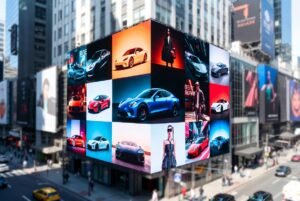
In the dynamic realm of experiential marketing, architectural integration, and digital out-of-home (DOOH) advertising, the pursuit of truly captivating visual experiences is paramount. Traditional flat LED displays, while powerful, often create visual breaks or require compromises when attempting to wrap around corners, disrupting the immersive flow. 90-degree corner LED screens represent a significant leap forward, offering a revolutionary solution that transforms conventional right-angle surfaces into continuous, flowing digital canvases. This technology eliminates the visible seams and distortions inherent in multi-panel corner installations, presenting a single, unbroken image that wraps seamlessly around architectural features.
The return on investment (ROI) from adopting 90-degree corner LED screens is multi-faceted. Businesses gain a distinctive competitive edge by delivering unparalleled visual impact, fostering deeper audience engagement, and elevating brand perception. These screens create ‘wow’ factor installations that stop passersby, increase dwell time in retail environments, and facilitate more memorable brand interactions. Architecturally, they blend display technology effortlessly into the built environment, creating kinetic sculptures rather than mere screens. For advertisers, this translates into premium placements with higher viewer retention and stronger message recall. The initial investment is offset by enhanced operational efficiency, reduced post-installation calibration complexities, and the long-term value derived from a superior, future-proof visual asset that consistently outperforms conventional display setups in aesthetic and functional appeal.
Introduction: Redefining Visual Boundaries
The evolution of LED display technology has been a relentless pursuit of greater visual fidelity, flexibility, and immersive power. From flat panels to curved arrays, each iteration has pushed the boundaries of what’s possible in digital signage and creative installations. However, a persistent challenge has been the seamless integration of displays around right-angle corners. Until recently, achieving a continuous visual experience on a 90-degree turn often involved compromises: visible bezels, misaligned pixels at the junction, or complex bespoke fabrication that introduced significant visual interruptions and engineering headaches.
The advent of specialized 90-degree corner LED screens fundamentally transforms this landscape. These innovative displays are engineered from the ground up to eliminate the visual discontinuity that plagued previous solutions. By designing bespoke corner modules and integrating advanced processing capabilities, manufacturers can now deliver truly seamless transitions, allowing content to flow unimpeded around architectural bends. This deep dive will explore the technical best practices for implementing these cutting-edge displays, focusing on how to achieve flawless 3D visuals that captivate audiences and unlock new dimensions of creative expression.
The Anatomy of a Seamless 90-Degree Corner LED Screen
Achieving true seamlessness at a 90-degree angle requires a meticulous blend of hardware innovation, mechanical precision, and sophisticated calibration. It’s far more than simply bending a flat panel; it involves rethinking the very structure of LED modules.
Specialized Module Design and Cabinet Engineering
The core of a seamless 90-degree corner LED screen lies in its unique module design. Unlike standard flat modules, specialized corner modules are precisely engineered to meet at a perfect 90-degree angle without leaving a gap or creating a ‘dark line’. This is often achieved through:
- True 90-Degree Corner Modules: These are not simply two beveled flat modules forced together. Instead, they are single, integrated units with LEDs populated directly onto a precisely angled PCB, ensuring pixel-perfect alignment and consistent pixel pitch right up to the corner. This eliminates the need for complex field-alignment of two separate panels.
- Beveled Edge Designs: In some designs, flat modules meet at an angle, but the edges are carefully beveled (e.g., 45 degrees) to allow two modules to form a 90-degree corner. The key here is the extremely tight tolerance and mechanical precision to ensure the angle is exact and light leakage is prevented.
- Integrated Cabinetry: The cabinets housing these modules are equally crucial. They must be robust, lightweight, and engineered with micron-level precision to ensure perfect mechanical alignment. Advanced heat dissipation solutions are often integrated, especially as the density of components in corner modules can lead to higher localized temperatures.
- Magnetic or Screw Fixation: While magnetic modules offer rapid installation and maintenance, screw-based systems can provide enhanced long-term stability and precise micro-adjustments, which are critical at corner junctions. The choice often depends on the installation’s permanence and accessibility for maintenance.
Precision Installation and Optical Calibration
Even with perfectly designed modules, the installation and subsequent calibration are paramount for achieving seamless visuals.
- Mechanical Precision: The physical alignment of each cabinet and module is critical. Any deviation, even by a fraction of a millimeter, can create visible seams, Moiré patterns, or misaligned content. Professional installation teams use laser-guided tools and highly accurate mounting systems to ensure perfect flatness and perpendicularity.
- Optical Calibration: Once physically installed, the display requires extensive optical calibration. This involves adjusting brightness, color temperature, and chromaticity across all modules to ensure absolute uniformity, particularly at the corner transition. Advanced cameras and software perform non-uniformity correction (NUC) to ‘stitch’ the visual output from different modules into a single, cohesive image. This process ensures that the light emission, especially at the critical corner junction, is visually indistinguishable from the rest of the display.
- Viewing Angle Optimization: Considering the multi-directional viewing angles inherent in a corner display, careful attention must be paid to LED binning and module selection to minimize color shift and brightness variation from oblique perspectives.
Pixel Pitch and Viewing Distance Considerations
The choice of pixel pitch (the distance between LED pixels) significantly influences the perceived seamlessness of the corner display. For installations where viewers will be close to the screen, a finer pixel pitch (e.g., P1.2mm – P2.5mm) is essential to ensure that individual pixels are not discernible, particularly at the corner. As viewing distance increases, a larger pixel pitch can be acceptable, but the principle remains: the finer the pixel pitch, the more forgiving the display is to minor imperfections and the more seamless the visual transition appears.
Achieving Flawless 3D Visuals: Content Creation and Processing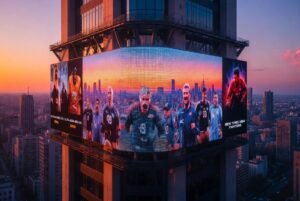
Hardware excellence is only half the equation; the true magic of 90-degree corner screens is unleashed through intelligently designed content and sophisticated processing.
Content Creation for Immersive Experiences
Designing content for a 90-degree display is fundamentally different from creating content for a flat screen. It requires a deep understanding of perspective, distortion, and the continuous nature of the canvas.
- Spatial Mapping: Content creators must visualize the display as a single, three-dimensional surface rather than two distinct flat planes. Specialized content mapping software (e.g., Resolume Arena, Notch, Disguise, MadMapper) is crucial. These tools allow artists to accurately project 2D or 3D content onto the specific geometry of the corner screen, correcting for perspective distortion and ensuring smooth animation flow.
- Leveraging the Corner: The corner itself becomes a creative element. Instead of avoiding it, content should be designed to flow seamlessly around it, using the angle to create depth, perspective shifts, or immersive tunnel effects. Anamorphic content, specifically designed to appear correct from a particular viewing angle, can be incredibly impactful for creating 3D illusions without glasses.
- Avoiding Distortion: A common pitfall is stretching flat content across the corner. This results in severe distortion and a broken visual. Content must be rendered or warped to respect the 90-degree bend, ensuring that objects appear consistent in size and shape as they traverse the corner. This often involves creating custom 3D models or environments that are then projected onto the screen’s geometry.
- Resolution and Aspect Ratios: Content must be rendered at the exact native resolution of the combined corner display. Understanding the combined horizontal and vertical pixel count is crucial for maintaining crisp visuals.
Synchronization and Advanced Video Processing
To deliver smooth, high-fidelity 3D visuals, robust video processing and synchronization are indispensable.
- High Refresh Rates: Essential for flicker-free motion, especially with fast-moving graphics or interactive content. Higher refresh rates (e.g., 3840Hz and above) ensure fluid transitions and reduce motion blur, contributing significantly to the immersive quality.
- Frame Synchronization (Genlock): In multi-panel setups, Genlock ensures that all modules and sending cards refresh their frames at precisely the same time, eliminating tearing or visual lag that could break the illusion of a seamless display.
- Advanced Video Processors: Modern LED video processors are sophisticated devices capable of handling multiple input sources, scaling content to native resolution, performing real-time color adjustments, and managing multi-window layouts. For corner displays, processors with robust output mapping capabilities are vital to correctly distribute the content across the unique display geometry.
- Color Depth and HDR: Supporting higher color depths (10-bit, 12-bit) and High Dynamic Range (HDR) content dramatically enhances the visual richness, contrast, and color accuracy, making 3D visuals more vibrant and lifelike.
- Redundancy: For mission-critical installations, processor and sending card redundancy ensures uninterrupted operation, preventing costly downtime and maintaining the immersive experience even in the event of component failure.
Technical Comparison Table: Integrated 90-Degree Corner vs. Traditional Flat Panel Corner
Understanding the fundamental differences between purpose-built 90-degree corner LED screens and traditional methods of creating a corner display highlights the advantages of the specialized solution:
| Feature | Traditional Flat LED Walls (Two Separate Sides Meeting) | Integrated 90-Degree Corner LED Screen (Specialized Modules) |
|---|---|---|
| Seam Visibility | Noticeable physical gap, potential for dark lines, misaligned pixels due to tolerances. | Near-invisible seam, uniform light emission across the corner, seamless pixel transition. |
| Visual Flow | Abrupt visual break at the corner, requiring content to stop/restart or be carefully segmented. | Continuous, fluid visual flow; allows for a single, unbroken canvas for content. |
| Content Design Complexity | Requires content to be aware of and adapt to the physical seam; often needs separate renders or complex warping. | Allows for single-canvas content design, leveraging specialized mapping software for continuous projection. |
| Installation Precision | Requires extremely precise alignment of two separate flat cabinets, complex structural support at the corner. | Modular installation with dedicated, pre-engineered corner pieces simplifies precise alignment and structural integrity. |
| Mechanical Integrity at Corner | Relies heavily on external support structures; potential for differential movement or gaps over time. | Integrated structural design provides superior long-term stability and consistent physical form. |
| Calibration at Corner | Challenging to achieve perfect color/brightness uniformity across two disparate panels meeting at an edge. | Designed for integrated optical and chromatic calibration across the seamless corner module. |
| Power & Data Routing | Often requires separate power/data paths for each side, potentially adding complexity. | Streamlined and integrated power/data routing simplifies cabling and reduces points of failure. |
| Total Cost of Ownership (TCO) | Lower initial module cost, but potentially higher installation, calibration, and ongoing maintenance costs due to complexity. | Higher initial specialized module cost, but significantly lower installation, calibration, and long-term maintenance complexity, leading to potentially lower TCO. |
Practical Implementation: Best Practices for Buying & Maintenance
Investing in a 90-degree corner LED screen is a strategic decision that demands careful consideration during both procurement and ongoing operation.
Buying Advice: Making the Right Investment
- Verify True Corner Capability: Not all “corner solutions” are equal. Insist on seeing demonstrations or detailed specifications of how the corner is formed. Does it use dedicated, integrated corner modules or merely beveled flat panels? The former offers superior seamlessness.
- Manufacturer’s Expertise: Choose a manufacturer with a proven track track record in specialized and creative LED display solutions. Their expertise in precision engineering, calibration, and content integration is critical. Ask for case studies of similar installations.
- Pixel Pitch and Viewing Environment: Match the pixel pitch to the primary viewing distance. For close-up, immersive experiences, finer pixel pitches are non-negotiable. Also consider ambient light conditions and brightness requirements.
- Total Cost of Ownership (TCO): Look beyond the initial module price. Factor in installation complexity, specialized rigging requirements, calibration time, power consumption, and expected lifespan. A higher upfront cost for a truly seamless solution often yields significant savings in the long run through reduced maintenance and superior performance.
- Content Management System (CMS) Integration: Ensure the display system integrates seamlessly with your existing or planned CMS. The ability to easily create, schedule, and deploy content specifically for the corner geometry is crucial for maximizing ROI.
- Service & Support: Evaluate the warranty, spare parts availability, and the manufacturer’s technical support capabilities. Given the specialized nature, prompt and knowledgeable support is essential.
- Power and Structural Considerations: Conduct thorough site surveys to assess power availability, heat dissipation requirements, and the structural integrity of the mounting location. These displays, especially large formats, can have significant power and weight demands.
Maintenance for Sustained Performance
- Regular Visual Inspections: Periodically inspect the display, paying close attention to the corner area, for any misaligned modules, dead pixels, or discrepancies in brightness/color. Early detection prevents minor issues from escalating.
- Proactive Thermal Management: Ensure ventilation systems (fans, HVAC) are operating effectively. Overheating can degrade LED performance and reduce lifespan. Clean filters regularly.
- Calibration Checks: While initial calibration is critical, environmental factors and component aging can lead to slight shifts. Schedule professional re-calibration (e.g., annually or bi-annually) to maintain optimal brightness and color uniformity across the entire display, particularly at the seamless corner.
- Software and Firmware Updates: Keep video processors, sending cards, and display control software updated. Manufacturers frequently release updates that improve performance, add features, or address bugs.
- Dust and Debris Removal: Gently clean the display surface using appropriate methods (e.g., soft, lint-free cloths, compressed air for dust). Avoid abrasive materials or harsh chemicals.
- Spare Parts Inventory: Maintain a small inventory of critical spare parts, especially modules and power supplies. This minimizes downtime in case of component failure.
FAQ Section: High-Level Technical Insights
Q1: What are the critical factors for achieving truly seamless visuals at the 90-degree corner?
A1: The absolute critical factors are threefold: First, precision engineering of the corner modules, ensuring pixel-perfect alignment and consistent pixel pitch directly onto an integrated 90-degree PCB. Second, micron-level mechanical installation and alignment to prevent physical gaps or misalignments. Third, advanced optical and chromatic calibration, utilizing sophisticated camera systems to achieve pixel-level brightness and color uniformity across the entire display, especially at the corner junction, eliminating any visible seam or color shift.
Q2: How does content creation for a 90-degree screen differ from a flat LED wall, and what tools are essential?
A2: Content creation for a 90-degree screen demands a shift from a 2D mindset to a 3D spatial understanding. Unlike flat walls where content is often linear, 90-degree screens require content that flows continuously around a bend, accounting for perspective distortion. Essential tools include advanced media servers and content mapping software (e.g., Disguise, Notch, Resolume Arena) that can accurately project and warp 2D or 3D content onto the specific 90-degree geometry of the display. This ensures elements appear correctly proportioned and seamlessly transition across the corner, rather than being stretched or cut.
Q3: What are the common pitfalls to avoid when implementing a 90-degree corner LED display?
A3: Several common pitfalls can undermine the effectiveness of a 90-degree corner display. Foremost is underestimating the required installation precision; even slight mechanical misalignments can destroy the seamless illusion. Another is inadequate content adaptation, where flat-screen content is simply stretched, leading to severe distortion at the corner. Neglecting long-term calibration maintenance can cause color and brightness inconsistencies over time. Finally, choosing a vendor without specialized expertise in true 90-degree solutions can result in a compromised ‘near-seamless’ display that fails to deliver the promised immersive experience.
Conclusion: The Future of Immersive Digital Architecture
90-degree corner LED screens are more than just advanced display technology; they are catalysts for architectural transformation and immersive storytelling. By meticulously addressing the challenges of seamless corner integration, these displays open up new avenues for designers, marketers, and architects to create environments that truly engage and captivate. They break free from the traditional rectangular confines of digital signage, allowing visuals to become an integral, fluid part of the physical space.
As technology continues to evolve, we anticipate even greater advancements in pixel pitch, flexibility, and processing power, making truly immersive digital architecture more accessible and impactful. For businesses seeking to differentiate themselves, elevate their brand, and create unforgettable experiences, embracing the best practices for 90-degree corner LED screens is not just an option—it’s a strategic imperative. Consult with a world-class LED display technical consultant today to explore how this groundbreaking technology can redefine your visual landscape and unlock unprecedented creative potential.