Introduction: Redefining Visual Storytelling Beyond the Rectangle
In an era saturated with digital content, standing out requires more than just high resolution; it demands innovation in form and function. Traditional rectangular LED displays, while powerful, often face limitations when it comes to integrating seamlessly into unique architectural designs or delivering truly captivating, immersive visual experiences. This is where creative LED displays—including spherical, curved, and irregular shapes—step in, revolutionizing visual communication. This comprehensive guide explores how customized LED display solutions are breaking conventional space limits, empowering architects, designers, and brands to forge unforgettable, immersive visual narratives that captivate audiences and transform environments into dynamic art.
 The Evolution of Visual Aesthetics: From Flat to Form
For decades, screens have been confined to flat, two-dimensional planes. However, advancements in LED technology, particularly in flexible and modular designs, have unleashed a new era of visual possibilities. The desire to create more engaging public spaces, iconic architectural landmarks, and memorable brand activations has fueled the demand for displays that can conform to, or even define, complex geometries.
The Limitation of Conventional Displays
Standard LED panels, while versatile, can feel restrictive when the vision calls for something truly unique. Achieving organic shapes, wrapping around structures, or creating freestanding sculptural displays was once technically challenging and prohibitively expensive. This pain point drove the innovation towards more adaptable and customizable LED solutions.
Pioneering Forms: Categories of Creative LED Displays
Creative LED displays manifest in various groundbreaking forms, each offering distinct advantages for specific applications.
- Spherical LED Displays: All-Encompassing Visuals
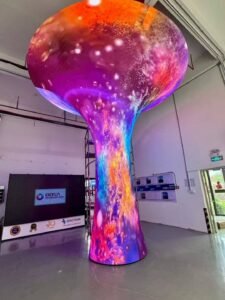
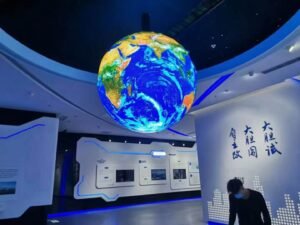
spherical screen is a true marvel of engineering, creating a 360-degree viewing experience where content literally wraps around the viewer. These displays offer a unique sense of immersion, making them ideal for a range of high-impact applications.
Applications of Spherical Screens
Spherical LED displays are commonly found in:
- Museums and Science Centers: For interactive planetary displays, celestial simulations, or historical recreations.
- Corporate Lobbies and Atriums: Creating a stunning focal point and delivering high-impact brand messaging.
- Entertainment Venues: Enhancing concerts, clubs, and themed attractions with panoramic visuals.
- Public Art Installations: As an architectural art display, transforming urban spaces into dynamic canvases.
Technical Considerations for Spherical Screens
The creation of a seamless spherical screen requires extremely precise module design, often utilizing trapezoidal or triangular LED panels that fit together perfectly. Advanced pixel mapping software is essential to correct distortions and ensure content is rendered flawlessly across the complex curvature. Structural integrity and heat management within a closed spherical form are also critical engineering challenges.
- Curved LED Displays: Dynamic Flow and Perspective
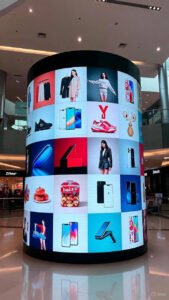
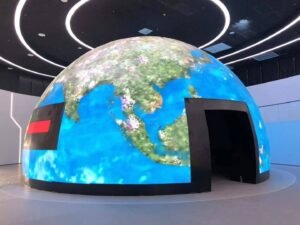 Curved screen technology adds a new dimension to visual storytelling, offering a natural flow that mimics human peripheral vision or integrates seamlessly with architectural lines. These can be
ave (curving inwards), convex (curving outwards), or even dynamically undulating.
Types and Applications of Curved Screens
Curved LED displays are highly versatile, appearing in:
- Sports Stadiums: Wrapping around fascias or creating dynamic corner displays.
- Concert Halls and Stages: Providing immersive backgrounds that extend the performance space.
- Retail Environments: Creating engaging product showcases or elegant digital signage that follows store aesthetics.
- Command and Control Centers: Ergonomically designed to improve operator viewing comfort and data overview.
The Enabler: Flexible LED Technology
The development of flexible LED modules has been instrumental in the widespread adoption of curved displays. These modules, often made with soft, pliable PCB boards, can be bent, twisted, and shaped to a variety of curves without compromising pixel integrity. This inherent adaptability makes them perfect for creating smooth, continuous curved surfaces that are impossible with rigid panels.
- Irregular and Custom-Shaped LED Displays: Artistic Freedom Unleashed
Beyond standard curves and spheres, the true artistic potential of LED lies in custom-shaped LED displays. These bespoke solutions break free from geometric constraints, allowing for displays that conform to any design vision, no matter how intricate.
Applications of Custom-Shaped LED Displays
Customized LED display solutions are limited only by imagination, often seen as:
- Brand Logos and Icons: Illuminated 3D logos that become dynamic display surfaces.
- Architectural Features: Wrapping around pillars, flowing along ceilings, or integrated into building facades as an architectural art display.
- Themed Environments: Creating unique shapes for amusement parks, art galleries, or experiential marketing.
 The Essence of Customized LED Display Solutions
The development and deployment of customized LED display solutions require close collaboration between the client, manufacturer, and installation teams. This involves custom module design, specialized structural fabrication, bespoke control systems for content mapping, and often, intricate onsite assembly. The focus is always on delivering a unique, tailored visual solution that perfectly aligns with the project’s aesthetic and functional requirements.
Core Technical Parameters for Creative LED Displays
While the form factor is captivating, the underlying technical prowess of these displays ensures their immersive impact.
- Pixel Pitch for Intricate Detail
For creative displays, especially those with complex curves or irregular shapes, selecting the right pixel pitch is crucial. A finer pixel pitch (e.g., P1.2 to P4 for indoor, P4 to P10 for outdoor applications depending on viewing distance) ensures that the content remains crisp and legible even when viewed from various angles and distances that might be dictated by the display’s unique form. This is paramount for preventing pixelation on intricate designs.
- Flexible LED Module Design
The innovation of flexible LED modules is the cornerstone of curved and irregular displays. These modules typically feature:
- Soft PCBs: Allowing for significant bending radius without damaging circuits.
- Magnetic or Screw-less Attachment: Facilitating quick and precise installation and maintenance.
- Lightweight Construction: Reducing structural load and easing handling during complex installations.
- High Refresh Rate and Gray Scale
Maintaining a high refresh rate (≥3840 Hz) and deep grayscale (16-bit or greater) is as important for creative displays as for conventional ones. This ensures smooth video playback, vibrant color reproduction, and seamless gradient transitions, critical for immersive content, especially when it’s viewed from multiple perspectives or involves complex animations.
- Advanced Control Systems
Complex shapes and non-standard resolutions demand sophisticated control systems. These systems must be capable of:
- Precise
xel Mapping: Distorting and mapping content accurately onto irregular surfaces.
[• Multi-Screen Synchronization: Ensuring seamless transitions and synchronized playback across multiple, often disparate, display sections.
- Real-time Content Management: Allowing for dynamic updates and scheduling of diverse visual narratives.
- Structural Integrity and Heat Dissipation
The unique physical forms of creative LED displays present specific structural and thermal management challenges. Each customized LED display requires a bespoke structural framework that is both robust enough to maintain the desired shape and allow for efficient heat dissipation to ensure longevity and stable performance. This often involves innovative cabinet designs and advanced cooling solutions.
 The Transformative Power of Architectural Art Display
When creative LED displays are integrated into buildings or urban environments, they transcend mere signage to become an architectural art display. This fusion of technology and design offers profound benefits:
Enhancing Urban Landscapes
Dynamic facades and public installations can transform stagnant urban spaces into vibrant, interactive environments, fostering community engagement and enhancing city aesthetics.
Creating Brand Icons
A bespoke customized LED display can become an iconic brand symbol, instantly recognizable and deeply embedded in the public consciousness, creating a powerful, immersive brand presence.
Delivering Unique Experiential Marketing
For events and brand activations, creative LED provides a platform for unparalleled experiential marketing, leaving lasting impressions on audiences through truly immersive visual spectacles.
Conclusion: Shaping Future Realities with Creative LED
The shift from conventional rectangles to dynamic forms is reshaping visual communication. Creative LED displays, including the mesmerizing spherical screen, the fluid curved screen, and infinitely adaptable flexible LED technology, powered by customized LED display solutions, are breaking architectural and artistic barriers. They empower businesses and designers to move beyond static visuals, creating vibrant, immersive environments that not only capture attention but fundamentally transform experiences.
For brands and urban planners looking to truly differentiate, investing in an architectural art display or a bespoke creative LED solution is a declaration of innovation, promising to forge unforgettable visual realities in public and commercial spaces worldwide.
Frequently Asked Questions (FAQ)
Q1: What defines a “customized LED display”?
A1: A customized LED display refers to an LED screen specifically designed and manufactured to fit non-standard shapes, sizes, or architectural curves, such as spheres, cylinders, waves, or irregular artistic forms. It goes beyond standard rectangular panels to achieve unique visual integrations.
Q2: What are the main benefits of using a spherical screen?
A2: A spherical screen offers a truly immersive 360-degree viewing experience, making it highly effective for public art, planetariums, museums, and grand commercial spaces. It provides a unique focal point and delivers content that wraps around the audience, creating a powerful visual spectacle.
Q3: How does flexible LED technology enable curved and custom-shaped displays?
A3: Flexible LED technology utilizes soft, pliable PCB (Printed Circuit Board) materials and modular designs that allow individual LED modules to be bent, twisted, or shaped to conform to various curved or irregular surfaces. This flexibility is essential for creating seamless curved screens and complex architectural art display installations.
Q4: What technical parameters are crucial for the performance of an architectural art display?
A4: For an architectural art display, crucial technical parameters include a fine enough pixel pitch for the intended viewing distance, high refresh rate for smooth content, deep grayscale for rich color reproduction, advanced control systems for precise content mapping onto complex geometries, and robust structural engineering to support the unique form.
Q5: Can creative LED displays be used both indoors and outdoors?
A5: Yes, customized LED display solutions can be designed for both indoor and outdoor applications. Outdoor creative LED displays require additional considerations for weather resistance (e.g., IP65 rating), higher brightness levels, and robust structural integrity to withstand environmental challenges, similar to standard outdoor LED displays but adapted for their unique forms.