
Maximize Your LED Display ROI: The Definitive Guide to Calculating Optimal Viewing Distance for Every Pixel Pitch
Maximize Your LED Display ROI: The Definitive Guide to Calculating Optimal Viewing Distance for Every Pixel Pitch
Executive Summary: Unlocking Unrivaled Visual Impact and Business Value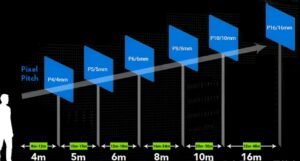
In today’s visually-driven business landscape, LED displays are no longer just screens; they are powerful tools for communication, branding, and engagement. However, the true potential and return on investment (ROI) of an LED display system are only fully realized when the display is perfectly matched to its viewing environment. A critical, yet often overlooked, factor in this equation is the optimal viewing distance relative to the display’s pixel pitch.
Incorrectly specifying an LED display can lead to significant financial implications: over-engineering with a fine pixel pitch for a distant audience wastes capital, while under-specifying for a close audience results in pixelated, unprofessional visuals that degrade brand perception and user experience. This deep-dive guide, authored by a world-class LED display technical consultant, provides you with the methodologies and insights to precisely calculate the optimal viewing distance, ensuring your investment delivers maximum visual impact, content clarity, and ultimately, superior business outcomes. By understanding and applying these principles, your organization can avoid costly errors, enhance audience engagement, and secure a competitive edge through truly captivating digital experiences.
Understanding the Core: Pixel Pitch and Optimal Viewing Distance
At the heart of every high-performance LED display lies its pixel pitch. Pixel pitch (P), measured in millimeters (mm), represents the distance between the centers of two adjacent LED pixels. This seemingly simple metric is the cornerstone for determining an LED display’s resolution capability, its potential for detail, and most importantly, its ideal viewing environment.
A smaller pixel pitch means more pixels per unit area, resulting in a higher pixel density and the ability to display finer details. Conversely, a larger pixel pitch means fewer pixels, lower resolution per unit area, but often higher brightness and better suitability for longer viewing distances. The concept of “optimal viewing distance” (OVD) refers to the range where the human eye perceives the content on the LED display with maximum clarity, comfort, and impact, without discernible pixelation or loss of detail. Achieving this balance is paramount for any successful LED display deployment.
Key Factors Influencing Optimal Viewing Distance
While pixel pitch is the primary driver, several other critical factors must be considered to precisely determine the optimal viewing distance for your LED display:
- Human Visual Acuity: The human eye’s ability to discern detail is a fundamental biological limit. For individuals with 20/20 vision, the eye can typically distinguish two points that are separated by approximately one arcminute (1/60th of a degree) of visual angle. This physiological benchmark underpins the foundational calculations for minimum viewing distance.
- Overall Display Resolution: While pixel pitch defines the density, the total number of pixels (width x height) determines the display’s overall resolution. A very large screen with a fine pixel pitch might have an incredibly high resolution, allowing for immense detail even at a distance, whereas a smaller screen with the same pixel pitch would offer similar detail but for a more confined viewing area.
- Content Type and Complexity: The nature of the content displayed profoundly influences the required viewing distance. Highly detailed graphics, intricate data visualizations, or small text require a closer viewing distance than large, bold text, simple branding, or general video footage.
- Audience Engagement and Interaction: Are viewers passively observing from a distance (e.g., outdoor billboard) or actively interacting up close (e.g., museum exhibit, control room)? The level of engagement dictates the necessary clarity and therefore the optimal viewing distance.
- Environmental Lighting Conditions: Ambient light levels (indoor vs. outdoor, bright daylight vs. dim evening) affect perceived contrast and legibility. While not directly altering the pixel pitch calculation, extreme lighting conditions can impact the subjective “optimal” experience, potentially necessitating a brighter display or a different content strategy if visibility is compromised.
- Spatial Constraints: The physical layout of the installation site – room dimensions, available floor space, typical traffic flow – often imposes practical limitations on how close or far viewers can be from the display.
Calculating Optimal Viewing Distance: Methodologies and Practical Application
As a world-class consultant, we utilize a combination of industry-standard rules of thumb and more precise calculation methods to ensure an optimal outcome for your specific application.
1. The Minimum Viewing Distance (MVD) – The “Pixel-Free” Threshold
The MVD is the closest distance at which an average person with 20/20 vision can no longer discern individual pixels, resulting in a smooth, contiguous image. This is often based on the 1 arcminute visual acuity standard.
- Industry Rule of Thumb: A widely accepted and practical approximation for MVD is simply:
Minimum Viewing Distance (Meters) = Pixel Pitch (mm)Example: For a P2.5mm LED display, the minimum viewing distance where pixels blend seamlessly is approximately 2.5 meters.
This rule is incredibly useful for initial planning and ensuring that your audience isn’t subjected to a pixelated image when standing too close.
2. The Optimal Viewing Distance (OVD) – The Sweet Spot for Clarity and Comfort
The OVD goes beyond merely eliminating pixelation. It identifies the distance range that offers the best overall visual experience, balancing detail, comfort, and impact. This range typically provides a slightly more relaxed viewing experience than the absolute MVD, allowing for slight variations in visual acuity among viewers.
- Industry Rule of Thumb: A robust guideline for OVD is a multiplier of the pixel pitch:
Optimal Viewing Distance (Meters) = Pixel Pitch (mm) × 2 to 3Example: For a P2.5mm LED display:
- Minimum end of optimal: 2.5mm × 2 = 5 meters
- Maximum end of optimal: 2.5mm × 3 = 7.5 meters
Thus, the optimal viewing range for a P2.5mm display would be roughly 5 to 7.5 meters.
The lower end of this range (x2) prioritizes detail, while the higher end (x3) emphasizes comfort and broader visual appeal, particularly for dynamic content. Your choice within this range should be guided by content type and audience interaction.
3. The Maximum Viewing Distance (MAXVD) – Legibility at a Glance
The MAXVD is the furthest distance at which content can still be reasonably perceived and understood, even if fine details are lost. This is less about image quality and more about message legibility.
- Industry Rule of Thumb: This often relates more to the physical height of the display or the size of the content elements:
Maximum Viewing Distance (Meters) ≈ Display Height (Meters) × 10Or, less commonly for pixel pitch, but still relevant:
Maximum Viewing Distance (Meters) = Pixel Pitch (mm) × 10Example: For a P10mm outdoor display (where the MVD is 10 meters, and OVD 20-30 meters), the content might still be legible up to 100 meters, provided the text and graphics are sufficiently large.
Practical Scenarios and Application Examples
Let’s consider how these calculations apply to common business applications:
- Control Rooms & Boardrooms (e.g., P1.25 – P1.8mm): These environments demand exceptionally fine detail for critical data analysis and professional presentations. With viewing distances often ranging from 2 to 6 meters, a P1.25mm display would have an MVD of 1.25m and an OVD of 2.5m to 3.75m. This ensures executives and operators can view intricate charts and real-time data without pixelation or eye strain.
- High-End Retail & Corporate Lobbies (e.g., P2.5 – P3.9mm): For immersive branding and engaging promotional content, viewers might be 3 to 10 meters away. A P2.5mm display (MVD 2.5m, OVD 5m-7.5m) is ideal here, offering stunning visuals that captivate passersby.
- Indoor Sports Arenas & Houses of Worship (e.g., P4 – P6mm): For larger indoor venues, audiences are typically 8 to 20 meters from the screen. A P4mm display (MVD 4m, OVD 8m-12m) provides excellent clarity for replays, live feeds, and announcements across a broad audience.
- Outdoor Advertising & Stadiums (e.g., P6 – P16mm+): For vast outdoor spaces where viewers are often 15 meters to hundreds of meters away, larger pixel pitches are more appropriate. A P10mm display (MVD 10m, OVD 20m-30m) offers excellent visibility for large-format advertisements and scoreboard information, even under bright daylight conditions.
Technical Comparison Table: Pixel Pitch vs. Optimal Applications
To further illustrate the critical relationship between pixel pitch and application, consider the following comparative analysis:
| Feature/Metric | Fine Pixel Pitch (e.g., P0.9 – P2.5) | Medium Pixel Pitch (e.g., P2.6 – P6) | Large Pixel Pitch (e.g., P6 – P20+) |
|---|---|---|---|
| Common Applications | Control Rooms, Boardrooms, xR Stages, Broadcast Studios, High-End Retail (close-up) | Indoor Advertising, Corporate Lobbies, Houses of Worship, Convention Centers, Live Events | Outdoor Billboards, Stadium Perimeters, Public Information Displays, Building Facades, Large Venues |
| Typical Min. Viewing Distance (MVD, approx.) | 0.9m – 2.5m | 2.6m – 6m | 6m – 20m+ |
| Typical Optimal Viewing Distance (OVD, approx.) | 1.8m – 7.5m | 5.2m – 18m | 12m – 60m+ |
| Key Advantage | Unparalleled detail, seamless image at close range, immersive experience for critical content. | Versatility, good balance of cost/performance, suitable for a wide range of indoor and sheltered outdoor uses. | High brightness, weather resistance, cost-effective for very large scales and extremely long viewing distances. |
| Primary Consideration | Higher acquisition cost, precise installation required, high content resolution necessary. | Broader application scope, moderate cost, good visual impact for mixed content. | Best for long-distance viewing; fine detail less critical; visual impact derived from scale and brightness. |
| Content Type Best Suited For | Detailed data, intricate graphics, small text, high-resolution video, close-up interactive content. | Mixed media, general advertising, live feeds, presentations, branding, digital art. | Large text, simple graphics, branding, live scores, directional information, dynamic advertisements. |
Practical Implementation: Buying and Maintenance Advice
Leveraging these insights in your LED display strategy is paramount:
- Strategic Buying Advice:
- Define Your Application First: Clearly articulate the primary purpose of the display (information, advertising, entertainment, data visualization) and the typical content it will show.
- Measure Actual Viewing Distances: Do not guess. Physically measure the minimum, maximum, and most common viewing distances from potential audience positions. This is the most crucial step.
- Consider Your Audience: How critical is detail to your audience? Are they actively scrutinizing the screen or merely glancing?
- Budget vs. Performance: Understand the direct correlation between pixel pitch and cost. A finer pixel pitch incurs higher material and often installation costs. Ensure your investment is justified by the viewing distance.
- Future-Proofing: Anticipate future content requirements. Will you be displaying higher-resolution video or more detailed graphics in the coming years? Factor this into your pixel pitch decision.
- Consult an Expert: Engage with a world-class LED display technical consultant (like us!) to guide you through the selection process, ensuring a tailored solution that maximizes your ROI.
- Proactive Maintenance Advice (Indirectly related to OVD but crucial for sustained performance):
- Regular Calibration: Over time, individual LED modules can drift in color and brightness. Regular calibration ensures uniform visual quality, maintaining the display’s effectiveness even at its optimal viewing distance.
- Environmental Control: For indoor displays, maintaining stable temperature and humidity prolongs the lifespan of the LEDs and associated electronics, ensuring consistent visual performance.
- Content Optimization: Ensure your content is designed with the chosen pixel pitch and optimal viewing distance in mind. High-resolution content for fine-pitch displays, and simplified, bold graphics for larger pitches, ensures maximum impact.
FAQ Section: High-Level Technical Questions Answered
Q1: Is a smaller pixel pitch always a superior choice for an LED display?
A1: Not necessarily. While a smaller pixel pitch offers higher resolution and the ability to display finer details, it also comes with a higher cost. If your primary audience is positioned at a significant distance from the display, the additional resolution provided by a very fine pixel pitch becomes imperceptible to the human eye, rendering the extra investment redundant and inefficient. The optimal choice is always the pixel pitch that perfectly aligns with the required viewing distance for your specific application, balancing visual fidelity with cost-effectiveness.
Q2: How does ambient light affect the determination of optimal viewing distance for my LED display?
A2: Ambient light primarily influences the required brightness (nits) of your LED display rather than directly altering the optimal viewing distance calculation, which is fundamentally based on pixel pitch and human visual acuity. However, in environments with very high ambient light (e.g., direct sunlight), a display with insufficient brightness can make content appear washed out and illegible from a distance, even if the pixel pitch is theoretically optimal. Therefore, while not changing the OVD formula, high ambient light conditions may necessitate selecting a brighter display with an appropriate pixel pitch to ensure visibility and maintain the intended visual impact at the calculated optimal distance.
Q3: Can I use the same pixel pitch LED display for both indoor and outdoor applications interchangeably?
A3: It is generally not advisable to use the same LED display for both indoor and outdoor applications interchangeably due to fundamental design differences. Outdoor displays require significantly higher brightness (typically 5,000 to 10,000+ nits) to contend with direct sunlight, robust weatherproofing (higher IP ratings) to withstand environmental elements like rain and dust, and often larger pixel pitches because viewing distances are typically much greater. Indoor displays, conversely, prioritize higher resolution and color accuracy at much lower brightness levels (typically 800 to 2,500 nits) for comfortable close-range viewing. Attempting to use an indoor display outdoors would result in poor visibility and potential damage, while an outdoor display used indoors would be excessively bright and inefficient.