
Revolutionizing Durability: GOB Technology Eliminates LED Loss in High-Traffic Indoor Displays
Revolutionizing Durability: GOB Technology Eliminates LED Loss in High-Traffic Indoor Displays
In the dynamic world of indoor LED displays, visual impact and reliability are paramount. However, conventional Surface-Mount Device (SMD) LED screens, while offering stunning visuals, often face a formidable adversary in high-traffic environments: physical impact, dust ingress, and moisture exposure. These challenges frequently lead to LED loss, pixel failure, and a compromised viewing experience, ultimately impacting business continuity and brand perception. This deep-dive article explores Glue On Board (GOB) technology, an innovative solution specifically engineered to overcome these vulnerabilities, delivering unparalleled durability and a superior total cost of ownership (TCO) for demanding indoor applications.
Executive Summary: Unlocking Uninterrupted Performance and ROI with GOB Technology
For businesses deploying LED displays in bustling indoor locations—such as retail environments, transportation hubs, corporate lobbies, or entertainment venues—the cost of downtime, maintenance, and premature replacement due to LED loss can be substantial. GOB technology offers a strategic investment that significantly enhances the longevity, reliability, and visual integrity of LED displays. By encapsulating the entire LED module surface with a robust, transparent epoxy resin, GOB fundamentally transforms the display’s resistance to physical damage, dust, moisture, and static electricity.
The business value proposition of GOB technology is compelling:
- Extended Lifespan: Drastically reduces the likelihood of individual LED failures caused by external factors, prolonging the operational life of the display.
- Reduced Maintenance Costs: Fewer dead pixels mean less frequent repairs, lower labor costs, and decreased spare parts inventory.
- Enhanced Reliability & Uptime: Ensures continuous, high-quality content delivery, crucial for brand messaging, information dissemination, and revenue generation.
- Superior Visual Experience: Maintains pristine image quality over time, reflecting positively on brand image and customer engagement.
- Lower Total Cost of Ownership (TCO): While initial investment might be slightly higher, the long-term savings from reduced failures, maintenance, and replacement cycles yield a significantly lower TCO.
Adopting GOB technology is not merely a technical upgrade; it is a strategic business decision that safeguards your investment, guarantees an uninterrupted visual presence, and reinforces your commitment to quality and operational excellence.
The Achilles’ Heel of Standard Indoor LED Displays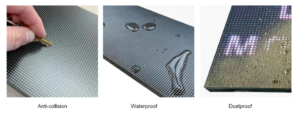
Standard SMD LED displays, where individual LED lamps are exposed on the PCB surface, are marvels of visual engineering. However, their delicate nature presents inherent weaknesses in specific environments.
- Physical Vulnerability: Each microscopic LED chip is susceptible to impact from hands, objects, cleaning tools, or even accidental bumps. This often leads to dead pixels, color inconsistencies, or complete module failure.
- Environmental Contaminants: Dust, moisture, and humidity can infiltrate the gaps between LEDs, causing short circuits, corrosion, or degradation of optical components.
- Static Electricity: Static discharge can damage sensitive LED chips, leading to sudden failures.
- Cleaning Challenges: The intricate surface makes cleaning difficult, often requiring specialized, gentle methods to avoid damage, yet dust and grime accumulation is inevitable.
These vulnerabilities are particularly pronounced in high-traffic areas where human interaction, environmental fluctuations, and cleaning routines are constant factors. The resultant LED loss not only diminishes the aesthetic appeal but also compromises the intended message and reflects poorly on the display’s owner.
Introducing GOB Technology: The Indestructible Shield
GOB (Glue On Board) technology emerges as a game-changer by directly addressing these critical vulnerabilities. At its core, GOB is an advanced encapsulation process where the entire surface of an LED display module—including all individual LED lamps and their delicate circuitry—is coated with a specialized, highly transparent, and robust epoxy resin or polymer glue. This protective layer is applied evenly across the board, effectively sealing the LEDs and creating an impenetrable barrier against external threats.
How GOB Technology Works Its Magic
The GOB process involves several sophisticated steps:
- Module Preparation: Standard LED modules are manufactured with SMD LEDs.
- Vacuum Potting/Coating: The modules are placed in a specialized vacuum chamber where the high-polymer composite material is evenly applied. The vacuum environment ensures the resin penetrates all micro-gaps and air bubbles are eliminated, guaranteeing a uniform, void-free, and strong bond.
- Curing: The coated modules undergo a controlled curing process, typically involving UV light or heat, to solidify the resin into a hard, transparent, and protective layer.
The resulting GOB display boasts a smooth, uniform surface that is fundamentally different from traditional SMD screens. The encapsulant itself is meticulously engineered for optimal performance, featuring high transparency (minimizing light loss), anti-UV properties (preventing yellowing over time), anti-static characteristics, and exceptional hardness.
Key Advantages and Benefits of GOB LED Displays
The implementation of GOB technology yields a multitude of operational and commercial benefits:
-
Superior Impact Resistance
This is GOB’s most prominent advantage. The hardened resin layer acts as a shock absorber, diffusing direct impacts and preventing damage to the sensitive LED chips underneath. This drastically reduces the incidence of dead pixels from accidental collisions, a common occurrence in public spaces.
-
Comprehensive Environmental Protection
The seamless GOB layer creates a formidable barrier against dust, moisture, and humidity. This prevents ingress of contaminants that can lead to short circuits, corrosion, and display degradation. It also makes cleaning significantly easier and safer, as the smooth surface can be wiped down without fear of dislodging LEDs.
-
Enhanced Anti-Static Capability
The encapsulating material often possesses anti-static properties, shielding the delicate LED components from electrostatic discharge (ESD), a frequent cause of latent or immediate LED failure.
-
Improved Visual Performance and Consistency
While some early GOB iterations might have marginally affected brightness or viewing angles, modern GOB technology, with its highly transparent resins, has largely overcome these concerns. In fact, some advanced GOB formulations can even improve display contrast and color uniformity by reducing light scattering and reflections, contributing to a more vivid and consistent visual experience over the display’s lifetime. The absence of dead pixels ensures uninterrupted visual flow.
-
Extended Lifespan and Reliability
By mitigating the primary causes of LED failure—physical impact and environmental exposure—GOB technology substantially extends the operational lifespan of the LED display. This translates directly to enhanced reliability and uptime, crucial for applications where continuous operation is expected.
-
Reduced Total Cost of Ownership (TCO)
Though the initial investment for GOB displays might be marginally higher than standard SMD, the long-term savings are significant. Reduced maintenance calls, fewer replacement modules, and a longer overall display life equate to a lower TCO, providing a strong return on investment.
Technical Comparison: GOB vs. Standard SMD LED Displays
To provide a clearer understanding of GOB technology’s advantages, here’s a technical comparison with standard SMD LED displays:
| Feature/Parameter | Standard SMD LED Display | GOB LED Display |
|---|---|---|
| LED Protection | Exposed individual LEDs on PCB surface | Full module surface encapsulated with transparent resin |
| Impact Resistance | Low; highly susceptible to physical damage, leading to LED loss. | High; robust protective layer resists impact, significantly reducing LED loss. |
| Dust & Moisture Protection | Low; vulnerable to dust accumulation and moisture ingress between LEDs. | High; sealed surface prevents dust and moisture penetration, IP ratings often higher for the module face. |
| Anti-static Capability | Moderate; LEDs directly exposed to potential static discharge. | High; protective layer provides an additional barrier against ESD. |
| Scratch Resistance | Low; exposed LEDs can be easily scratched or dislodged. | High; hardened resin layer offers superior scratch resistance. |
| Thermal Management | Direct heat dissipation from LED package. | Effective heat dissipation (resin can slightly insulate, but modern GOB materials are thermally optimized). |
| Optical Performance (Clarity, Contrast) | Excellent, but prone to degradation from dust/damage. | Excellent; modern GOB has minimal impact, can even enhance contrast/uniformity. Resists degradation from surface contaminants. |
| Repairability (Individual LED) | Possible but delicate and time-consuming. | Difficult to impossible; typically requires module replacement if severely damaged. |
| Lifespan Expectancy | Subject to environmental conditions and physical interactions. | Extended; significantly less prone to premature failure from external factors. |
| Maintenance Frequency | Higher due to vulnerability, more frequent cleaning required. | Lower due to enhanced protection and easier cleaning. |
| Initial Cost | Generally lower. | Slightly higher due to advanced manufacturing process and materials. |
| Total Cost of Ownership (TCO) | Potentially higher due to frequent repairs and shorter lifespan in demanding environments. | Significantly lower over the long term due to reduced maintenance and extended lifespan. |
| Suitable Environments | Controlled indoor environments with low traffic. | High-traffic indoor environments, retail, public spaces, demanding commercial applications. |
Practical Implementation: Buying and Maintenance Advice
Buying Advice for GOB LED Displays
When considering GOB LED displays for your next project, thorough due diligence is crucial:
- Assess Your Environment: Clearly define the level of traffic, potential for impact, and environmental conditions (dust, humidity) in your intended installation area. GOB is a premium solution best justified in challenging environments.
- Verify GOB Quality: Not all GOB solutions are created equal. Inquire about the type and quality of the encapsulant material used (e.g., high transparency, UV stability, hardness). A poorly formulated resin can yellow, crack, or affect optical performance.
- Manufacturer Reputation: Choose reputable manufacturers known for their quality control in GOB processes. Ask for case studies and references for similar applications.
- Pixel Pitch Considerations: While beneficial for all pitches, GOB is particularly valuable for fine pixel pitch displays (<2.5mm) where LEDs are smaller, more numerous, and inherently more delicate.
- Thermal Management Design: Ensure the display’s overall thermal design adequately dissipates heat, as the GOB layer adds a slight insulation. Modern GOB panels are engineered to manage this effectively.
- Warranty and Support: Understand the warranty terms, especially regarding dead pixels and module replacement. Comprehensive support is vital for long-term operational success.
Maintenance Advice for GOB LED Displays
While GOB significantly reduces maintenance frequency, proper care still ensures optimal performance:
- Simplified Cleaning: The smooth, sealed surface of a GOB display makes cleaning much easier and safer. Use a soft, lint-free cloth dampened with a mild, non-abrasive cleaning solution (e.g., isopropyl alcohol diluted with water) to remove dust and smudges. Avoid harsh chemicals or abrasive materials.
- Regular Visual Inspections: Periodically check the display surface for any signs of physical damage (e.g., deep scratches, cracks in the resin, though rare). While GOB is tough, extreme impacts can still cause issues.
- Environmental Control: Continue to monitor ambient temperature and humidity to ensure they remain within the manufacturer’s specified operating ranges, regardless of GOB protection.
- Module Replacement Strategy: Understand that in the rare event of severe damage (e.g., a deep crack affecting multiple LEDs), individual LED repair is typically not feasible with GOB. The recommended solution is usually module-level replacement. Stocking a few spare modules can minimize downtime.
Frequently Asked Questions (FAQ)
Q1: Is GOB technology suitable for outdoor applications?
A1: While GOB technology offers enhanced protection against dust and moisture, it is primarily designed for high-traffic indoor environments. Traditional outdoor LED displays typically utilize more robust, fully encapsulated SMD or DIP technologies designed to withstand extreme weather conditions, direct sunlight, and wide temperature fluctuations. While some advancements are exploring GOB for semi-outdoor or sheltered outdoor use, it is not currently its primary strength for extreme outdoor exposure.
Q2: Does GOB technology affect the visual quality of the display, such as brightness or viewing angle?
A2: Modern GOB technology, utilizing high-quality, ultra-transparent epoxy resins, has minimal to no discernible negative impact on visual quality. Reputable manufacturers ensure that the encapsulant maintains high light transmittance, preserving brightness and color accuracy. In some cases, the GOB layer can even slightly improve contrast and uniformity by reducing surface reflections and scattering, leading to a more stable and vibrant image over time. Any marginal reduction in brightness or alteration of viewing angle is typically negligible and well within acceptable commercial display parameters.
Q3: How does GOB technology impact the repair process for individual LEDs or modules?
A3: GOB technology significantly reduces the need for individual LED repairs by protecting them from common causes of failure. However, if a severe impact or internal component failure does occur, repairing individual LEDs within a GOB module is extremely difficult, if not impossible, due to the encapsulating resin. In such rare instances, the standard repair procedure is to replace the entire damaged module. The drastically reduced frequency of failures due to GOB protection often outweighs the inability to perform micro-repairs, as overall maintenance becomes simpler and less frequent.
Conclusion
GOB technology represents a significant leap forward in the durability and reliability of indoor LED displays. By providing an unyielding shield against the common culprits of LED loss—physical impact, dust, and moisture—GOB ensures uninterrupted visual performance, reduced maintenance burdens, and a substantially lower total cost of ownership. For businesses operating in high-traffic, demanding indoor environments, embracing GOB technology is not just an upgrade; it’s an imperative investment that secures display longevity, safeguards brand reputation, and delivers a consistently superior visual experience for years to come. In an era where digital presence is paramount, GOB ensures your message shines brightly, consistently, and without compromise.