Mastering the Sphere: Advanced Engineering for Unrivaled Visual Uniformity and Structural Integrity in Spherical LED Displays
Mastering the Sphere: Advanced Engineering for Unrivaled Visual Uniformity and Structural Integrity in Spherical LED Displays
Executive Summary: The ROI of Precision Spherical LED Engineering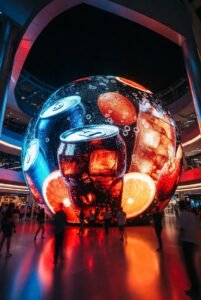
In an increasingly competitive landscape, creating truly immersive and memorable visual experiences is paramount for brand differentiation and visitor engagement. Spherical LED displays stand at the forefront of this innovation, offering unparalleled visual impact that captivates audiences from every angle. However, the true value and long-term return on investment (ROI) of these magnificent installations lie not just in their aesthetic appeal, but in the sophisticated engineering that underpins their structure and guarantees impeccable visual uniformity. For discerning businesses, investing in a spherical LED display engineered with world-class precision translates directly into extended operational longevity, minimal maintenance overheads, and a consistently stunning display that reinforces brand prestige. This deep dive explores the critical structural considerations, advanced module design, and cutting-edge calibration techniques that collectively ensure a spherical LED display delivers on its promise of an enduring, seamless, and visually breathtaking experience, significantly reducing total cost of ownership (TCO) and future-proofing your investment in experiential technology.
The Structural Engineering Imperative: Building the Foundation of Visual Excellence
The construction of a spherical LED display is a triumph of geometry, material science, and structural mechanics. Unlike conventional flat panels, spherical structures present unique engineering challenges that demand a meticulous approach to design and fabrication.
Geometry Challenges and Polyhedral Approximation
At its core, transforming flat LED panels into a seamless sphere requires a sophisticated understanding of polyhedral geometry. Large-scale spherical displays are typically constructed from numerous flat or gently curved trapezoidal or triangular LED modules, which are precisely assembled to approximate a smooth spherical surface. This modularity often leverages principles derived from platonic solids, such as the icosahedron or dodecahedron, which offer inherent structural stability and minimize visual gaps. The accuracy of these module shapes and the precision of their interconnections are fundamental to achieving both structural integrity and visual continuity.
Material Science and Load-Bearing Frameworks
The internal support structure of a spherical LED display is its backbone. This framework must be robust enough to withstand significant loads, including the weight of the LED modules, internal cabling, power supplies, and in outdoor applications, environmental forces such as wind loads, seismic activity, and snow accumulation. High-strength, lightweight alloys, predominantly aircraft-grade aluminum or specialized steel alloys, are carefully selected for their strength-to-weight ratio and corrosion resistance. Advanced Finite Element Analysis (FEA) is indispensable during the design phase, simulating various load conditions and thermal expansion scenarios to predict structural behavior and optimize material usage. This ensures the display maintains its perfect spherical shape without deformation over decades of operation.
Modularity, Assembly, and Thermal Management
Effective modular design not only facilitates easier manufacturing and transportation but also streamlines on-site assembly and future maintenance. Each LED module must be designed for quick, precise attachment to the internal framework, often utilizing custom-designed quick-lock mechanisms that ensure consistent alignment and secure connections. Crucially, spherical displays, particularly enclosed ones, pose significant thermal management challenges. The internal volume can trap heat, leading to elevated operating temperatures that degrade LED lifespan and color consistency. Engineers employ sophisticated thermal dissipation strategies, including optimized internal convection pathways, integrated cooling fans, high-efficiency heat sinks on individual modules, and in some larger installations, integrated HVAC systems to maintain optimal operating temperatures and extend the display’s service life.
Pixel Module Design for Spherical Surfaces
The individual LED modules are the building blocks of the visual experience, and their design for spherical applications is far more intricate than for flat displays.
Flexible PCB vs. Segmented Rigid Panels
Two primary approaches exist for manufacturing LED modules suitable for spherical surfaces: flexible PCBs and segmented rigid panels. Flexible PCBs offer the advantage of conforming to tight curves, potentially enabling a smoother surface with fewer visible seams. However, they can present challenges in heat dissipation, uniform pixel density across highly curved areas, and long-term structural stability for very large installations. For most large-scale, high-resolution spherical displays, segmented rigid panels (e.g., trapezoidal or triangular) are preferred. These panels, though individually flat or gently pre-curved, are meticulously designed to interlock, creating the spherical geometry. Rigid panels offer superior heat dissipation, better component protection, easier field replacement, and generally achieve higher pixel density uniformity and flatness across the module surface, which is critical for visual consistency.
Pixel Density, Viewing Angle, and Inter-module Connectivity
The choice of pixel pitch (density) directly impacts the viewing distance and perceived resolution. For spherical displays, where viewers might approach from any direction, a wider viewing angle for each LED is paramount to maintain color and brightness consistency across oblique perspectives. Furthermore, robust and redundant power and data connections between modules are critical. These connections must not only ensure reliable signal transmission but also withstand thermal expansion/contraction and the stresses of assembly and disassembly. Advanced manufacturers utilize custom-designed, gold-plated connectors with secure locking mechanisms to guarantee consistent performance.
Achieving Visual Uniformity: The Art and Science of Seamless Spherical Display
Beyond structural integrity, the ultimate measure of a spherical LED display’s success is its visual uniformity. This is a complex undertaking given the non-planar surface and multi-directional viewing angles.
Challenges of Non-Planar Surfaces
Unlike flat displays, where pixel arrays are straightforward, spherical surfaces introduce inherent challenges. Viewers perceive different parts of the sphere from varying distances and angles, leading to potential perspective distortion, color shifts, and brightness inconsistencies. Visible seams between modules, even if structurally minimized, can disrupt the visual flow. Achieving a truly seamless and consistently uniform image across the entire 360-degree surface requires sophisticated solutions.
Advanced Calibration Systems
The cornerstone of visual uniformity in spherical LED displays is advanced calibration. This process goes far beyond standard 2D calibration:
- 3D Camera-Based Calibration: High-resolution, multi-axis robotic camera systems are employed to scan the entire spherical surface. These cameras precisely measure the brightness, color (chromaticity), and gamma response of every individual LED pixel from multiple vantage points.
- Proprietary Algorithms: Specialized software algorithms then process this vast dataset, creating a comprehensive 3D map of the display. This map identifies and compensates for even the slightest variations in LED output, module manufacturing tolerances, and spatial relationships. It dynamically adjusts the drive current for each pixel to ensure perfect brightness and color matching across the entire sphere, eliminating “hot spots” or visible color shifts.
- Real-time Compensation: Premium systems integrate ambient light sensors and internal temperature probes, allowing for dynamic, real-time adjustments to brightness and color temperature to maintain optimal visual fidelity under changing environmental conditions.
Pixel Mapping and Content Management
Even with perfect calibration, the display is only as good as the content it presents. Specialized media servers are essential for spherical displays:
- Spherical Content Warping: These powerful servers are equipped with advanced 3D rendering and warping engines. They take standard 2D or 3D content and intelligently stretch, distort, and map it onto the spherical canvas, ensuring that it appears seamless and geometrically correct from the primary viewing angles.
- Content Creation Considerations: For truly impactful experiences, content must be designed specifically for the spherical geometry. This often involves 3D animation, panoramic video, or generative art that embraces the unique immersive canvas, avoiding the pitfalls of simply stretching flat video.
- Anti-aliasing and Image Processing: High-end systems also incorporate real-time image processing techniques such as advanced anti-aliasing to smooth jagged edges and enhance the overall visual quality, crucial for close-up viewing on a large spherical surface.
Technical Comparison: Spherical LED vs. Standard Flat LED Displays
Understanding the fundamental engineering differences between spherical and standard flat LED displays highlights the complexity and advanced solutions required for the former.
| Technical Parameter | Standard Flat/Rectangular LED Display | Spherical LED Display |
|---|---|---|
| Geometry/Structure | Simple planar frame, rectilinear module arrangement | Complex polyhedral/curved internal truss, multi-faceted module arrangement |
| Module Design | Rigid, rectangular PCBs, uniform dimensions | Custom-shaped (trapezoidal/triangular), flexible, or pre-curved rigid PCBs; varied dimensions |
| Pixel Mapping/Calibration | 2D planar mapping, standard brightness/color uniformity calibration | Advanced 3D spherical mapping, multi-axis camera-based calibration for brightness, color, chromaticity, and geometric correction across all viewing angles |
| Visual Uniformity Challenge | Relatively straightforward to achieve, primary concern is panel-to-panel consistency | High complexity due to perspective distortion, multi-angle viewing, inter-module seams, and color gradient challenges |
| Thermal Management | Larger open surface area, often passive convection | Enclosed space, requiring optimized internal convection, forced air cooling (fans), and/or integrated HVAC solutions |
| Maintenance Access | Typically front or rear module access with standardized tools | Often requires specialized internal truss access, custom tools for module replacement, and potentially intricate safety protocols |
| Content Creation | Standard 2D video/image formats, easily scalable | Requires specialized 3D rendering, panoramic content, or intelligent warping for optimal impact and distortion avoidance |
Practical Implementation: Buying and Maintenance Advice for Your Spherical LED Display
To ensure a spherical LED display delivers its promise of enduring impact, meticulous attention to buying decisions and a proactive maintenance strategy are essential.
Professional Buying Advice
- Manufacturer Expertise & Proven Track Record: Prioritize manufacturers with extensive experience in designing, engineering, and installing large-scale spherical LED displays. Request case studies, client testimonials, and factory visit opportunities to assess their capabilities and quality control processes.
- Structural Integrity Documentation: Demand comprehensive documentation, including detailed structural drawings, material specifications, and Finite Element Analysis (FEA) reports, especially for large or outdoor installations. Ensure compliance with relevant building codes and safety standards.
- Advanced Calibration Technology: Inquire specifically about their 3D calibration process, software capabilities, and post-installation recalibration services. A manufacturer that can demonstrate robust, automated 3D calibration is critical for long-term visual uniformity.
- Modularity and Serviceability: Evaluate the ease of module replacement. Can individual modules be hot-swapped quickly and safely? What are the lead times for spare parts, and how comprehensive is their spare parts strategy?
- Content Ecosystem & Media Server Compatibility: Confirm that the display system is compatible with leading media server platforms and offers robust support for spherical content creation and management. Ask about their content partners or internal content development capabilities.
- Comprehensive Warranty & Support: A robust warranty covering both components and structure, coupled with responsive technical support, on-site service options, and proactive monitoring services, is crucial for mitigating operational risks.
Actionable Maintenance Advice
- Proactive Monitoring System: Implement a remote monitoring system that continuously tracks critical parameters such as internal temperature, humidity, power consumption, and individual module status. Early detection of anomalies can prevent minor issues from escalating.
- Scheduled 3D Recalibration: Even the most advanced systems can experience slight shifts over time due to environmental factors or component aging. Schedule periodic (e.g., annual or bi-annual) 3D camera-based recalibrations to maintain peak visual uniformity and compensate for any drift.
- Structural Integrity Audits: Conduct regular (e.g., annual) physical inspections of the internal framework, mounting points, fasteners, and cable routing. Check for any signs of fatigue, corrosion, or loosening components, especially for outdoor displays subject to environmental stresses.
- Module Replacement Strategy: Train internal staff or partner with a qualified service provider for rapid hot-swapping of individual modules. Maintain a strategic inventory of spare parts to minimize downtime in case of module failure.
- Surface Cleaning & Protection: Follow manufacturer guidelines for cleaning the display surface using approved, non-abrasive cleaning agents and methods. Ensure proper environmental sealing is maintained for outdoor or semi-outdoor installations.
- Software and Firmware Updates: Keep the display’s control system, media server, and module firmware updated to leverage performance enhancements, security patches, and new features.
Frequently Asked Questions (FAQ)
Q1: How critical is structural design for the longevity of a large spherical LED display?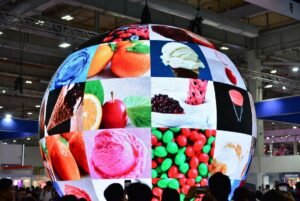
A1: Structural design is paramount. It forms the unyielding foundation for the entire display. A poorly designed or inadequately engineered structure will inevitably lead to issues such as uneven module alignment, internal stresses, compromised thermal management, and premature component failure. This directly impacts visual uniformity, necessitates frequent and costly repairs, and significantly shortens the display’s operational lifespan, ultimately eroding your initial investment. Robust structural engineering, verified by advanced analysis like FEA, is the primary guarantor of a spherical LED display’s longevity and consistent performance.
Q2: What are the key factors in achieving truly seamless visual uniformity on a sphere?
A2: Achieving seamless visual uniformity on a spherical LED display is a multi-faceted engineering challenge. Key factors include: precision-engineered LED modules with minimal gaps and consistent light output; advanced 3D camera-based calibration systems that meticulously measure and correct brightness, color, and chromaticity across the entire 360-degree surface; sophisticated pixel mapping software capable of warping content to the spherical geometry; and the creation of content specifically designed to leverage the unique canvas, avoiding distortions and maximizing immersion.
Q3: Can standard 2D video content be displayed effectively on a spherical LED screen?
A3: While standard 2D video content can be displayed on a spherical LED screen, its effectiveness is often limited. Specialized media servers can warp and project 2D content onto the spherical surface, but this typically results in noticeable stretching, distortion, or geometric inaccuracies, particularly towards the ‘poles’ or edges of the projected area. For optimal visual impact, a spherical LED display thrives on content specifically designed or adapted for its unique geometry. This includes panoramic video, immersive 3D animations, or generative art that fully utilizes the 360-degree canvas, providing an experience far superior to simply stretching conventional 2D media.
By understanding and prioritizing the advanced engineering principles behind spherical LED displays, businesses can confidently invest in these captivating technologies, ensuring they deliver exceptional visual experiences, enduring performance, and a strong, measurable return on investment for years to come.