Beyond the Screen: Maximizing Retail Impact with Holographic Fan Arrays or Transparent LED – A Deep Dive for ROI-Driven Signage Choices
Beyond the Screen: Maximizing Retail Impact with Holographic Fan Arrays or Transparent LED – A Deep Dive for ROI-Driven Signage Choices
Executive Summary: Elevating Retail Engagement and Driving Tangible ROI with Cutting-Edge 3D LED Signage
In the relentlessly competitive landscape of modern retail, attracting customer attention, enhancing brand perception, and ultimately driving sales are paramount. Traditional flat-panel displays, while functional, often struggle to cut through the digital noise. This comprehensive guide delves into two revolutionary 3D LED display technologies – Holographic Fan Arrays and Transparent LED Displays – that are redefining retail signage. Far more than mere visual novelties, these advanced solutions offer distinct advantages in capturing imagination, creating immersive brand experiences, and delivering measurable return on investment. By providing unprecedented visual dynamics, from seemingly floating 3D objects to vibrant content seamlessly integrated with architectural transparency, these technologies demonstrably increase foot traffic, extend dwell times, improve product recall, and cultivate a premium brand image. Understanding their technical nuances, practical applications, and strategic implementation is crucial for retailers looking to optimize their marketing spend and gain a significant competitive edge in an experience-driven economy. This deep dive empowers decision-makers with the insights needed to select the optimal 3D LED solution, transforming passive viewing into active engagement and tangible business growth.
Introduction: The Evolving Canvas of Retail Signage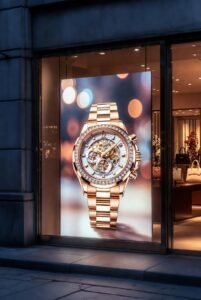
The digital transformation has reshaped consumer expectations, demanding richer, more interactive, and visually stunning experiences. Retail signage, once a static necessity, has evolved into a dynamic art form, a critical component of brand storytelling and customer journey optimization. As a World-Class LED Display Technical Consultant, we recognize that the future of retail engagement lies in technologies that transcend conventional flat screens, offering depth, dimension, and unexpected visual delight. Holographic Fan Arrays and Transparent LED Displays represent the vanguard of this revolution, each presenting a unique proposition for retailers seeking to differentiate, captivate, and convert. This article meticulously dissects these technologies, offering a strategic framework for their deployment in diverse retail environments.
Holographic Fan Arrays: The Illusion of True 3D
Understanding the Technology
Holographic Fan Arrays, often referred to as 3D holographic projectors, operate on the principle of persistence of vision (POV). These devices consist of a rapidly spinning array of LED light bars. As the blades rotate at high speeds, individual LEDs emit precise light sequences, creating a continuous, floating 3D image or animation that appears to hover in mid-air without a visible screen. The illusion is incredibly compelling, making objects seem tangible and volumetric, capable of being viewed from multiple angles within a defined sweet spot.
Key Advantages for Retail
- Unrivaled Visual Impact: The “floating” 3D effect is inherently mesmerizing, drawing immediate attention and significantly increasing passerby engagement. This novelty factor makes products or brand logos stand out dramatically.
- Enhanced Product Presentation: Ideal for showcasing products from all angles, allowing customers to visualize details that might be obscured in traditional displays. Imagine a sneaker rotating in mid-air or a new smartphone appearing to float.
- Brand Storytelling: Creates a magical, futuristic ambiance that elevates brand perception, associating the retailer with innovation and premium experiences.
- Compact and Versatile: Available in various sizes, from small desktop units to large arrays, allowing for flexible placement in windows, product displays, or interactive zones.
- Dynamic Content Potential: Capable of displaying intricate animations, product demonstrations, and brand messages that capture attention far more effectively than static visuals.
Considerations and Limitations
- Physical Presence and Mechanical Elements: As mechanical devices, they require careful installation and protection from physical interference. The spinning blades can be a safety concern in high-traffic, accessible areas unless properly enclosed.
- Optimal Viewing Angle: While offering a 3D effect, the illusion is most convincing within a specific viewing cone. Beyond this, artifacts or the blades themselves may become visible.
- Brightness and Resolution: Larger arrays can achieve impressive scale, but the perceived resolution might be less crisp than a high-definition flat LED screen. Brightness can also be a factor in direct, intense lighting conditions.
- Environmental Sensitivity: Dust accumulation on blades can affect visual quality and motor longevity. Airflow around the device needs to be considered to prevent overheating and ensure optimal performance.
- Content Creation: Requires specialized 3D content creation tailored to the device’s specific resolution and aspect ratio, which can be an additional investment.
Transparent LED Displays: Seamless Integration and Architectural Elegance
Understanding the Technology
Transparent LED Displays are revolutionary screens designed to be virtually invisible when not displaying content, allowing light and visibility to pass through them. Unlike traditional opaque LED walls, these displays feature a high transparency rate (typically 60-95%) achieved by mounting individual LED components onto a highly permeable substrate, often using a “strip” or “grid” design. When content is displayed, it appears vibrant and dynamic, while the background remains visible, creating a sophisticated layering effect.
Key Advantages for Retail
- Uninterrupted Views: Maintains natural light transmission and visibility into or out of the store, preserving architectural aesthetics and allowing customers to see merchandise inside even when the display is active.
- Large-Scale Architectural Integration: Ideal for large storefront windows, glass facades, and internal glass partitions, turning entire sections of a building into dynamic advertising canvases without blocking views.
- High Brightness for Outdoor Visibility: Often designed with high brightness capabilities, making them highly effective in direct sunlight, crucial for attracting attention in outdoor or brightly lit indoor environments.
- Robust and Durable: Typically engineered for demanding environments, offering excellent durability against environmental factors and prolonged operation.
- Creative Content Opportunities: Allows for fascinating content strategies where products or scenes inside the store can interact with the digital content displayed on the transparent screen, creating depth and engagement.
Considerations and Limitations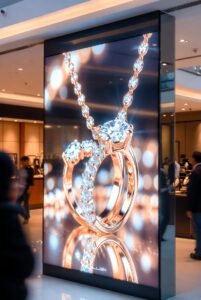
- Not “True” 3D: While capable of displaying 3D content (e.g., stereoscopic or anaglyph), the inherent effect is not the “floating” holographic illusion provided by fan arrays. Content appears on a transparent plane.
- Contrast Challenges: In extremely bright environments or against a very cluttered background, the contrast of the displayed content can be somewhat reduced compared to an opaque screen.
- Pixel Pitch vs. Transparency: Achieving very high transparency often comes with a trade-off in pixel pitch; ultra-fine pixel pitch transparent displays are more technologically challenging and thus more expensive.
- Installation Complexity: Large-scale transparent LED installations can require specialized structural support and careful integration with existing architectural elements.
- Cost: High-transparency, fine pixel pitch transparent LED displays can represent a significant upfront investment, though the ROI in terms of impact and architectural integration can be substantial.
Technical Comparison: Holographic Fan Arrays vs. Transparent LED Displays
Selecting between these two advanced 3D LED technologies requires a detailed understanding of their core technical specifications and performance metrics. The following table provides a professional comparison to guide your decision-making process.
| Feature/Specification | Holographic Fan Arrays (e.g., 65cm unit) | Transparent LED Displays (e.g., P3.9-7.8mm) |
|---|---|---|
| Display Type | Persistence of Vision (POV) via spinning LED blades | LED diodes on a highly transparent substrate (grid/strip design) |
| 3D Effect | True Holographic (floating, volumetric illusion) | 2D content on a transparent plane (perceived depth with specific content) |
| Transparency Level | N/A (object appears to float in open air) | High (typically 60% to 95%) |
| Brightness (nits) | 500 – 2000+ (depending on model/size) | 2000 – 6000+ (critical for daylight visibility) |
| Pixel Pitch (mm) | Varies, often equivalent to P1.5-P2.5 for perceived resolution at close range (e.g., 65cm diameter unit might have 720-1024 pixels vertically) | Fine to Medium (P2.9, P3.9, P7.8, P10.4, P15.6 etc. – P3.9-7.8mm being common for retail) |
| Optimal Viewing Distance | Closer range for best holographic effect (e.g., 1-5 meters) | Varies with pixel pitch (e.g., 3-10 meters for P3.9-7.8) |
| Viewing Angle | Specific “sweet spot” for optimal 3D illusion (e.g., 170° horizontal, but illusion strongest centrally) | Wide (e.g., 140°-160° horizontal/vertical) |
| Content Format | Specialized 3D models/animations (MP4, AVI, etc.) | Standard video & image formats (MP4, JPG, PNG, etc.) |
| Installation Complexity | Relatively simpler for standalone units; mounting brackets, power. Array integration more complex. | Can be complex for large-scale architectural integration (structural, cabling, power distribution). |
| Maintenance | Regular cleaning of blades, motor inspection, fan replacement potential. | Module replacement, routine cleaning of LED surface. Generally low. |
| Power Consumption | Relatively low for single units (e.g., 60W-200W per unit); scales with arrays. | Moderate to High (e.g., 150-500W/sqm average, peak higher) |
| Primary Use Case | Product highlights, captivating window displays, interactive exhibits, specific brand messaging. | Storefront windows, glass facades, architectural integration, interior partitions, large-scale advertising. |
| Environmental Factors | Sensitive to dust, moisture, physical impact; requires adequate spacing/enclosure. | Robust, often designed for outdoor weather (IP rated) and varying indoor conditions. |
Practical Implementation: Strategic Buying and Maintenance Advice
The decision to invest in advanced 3D LED signage is a strategic one, demanding careful planning for both acquisition and long-term operation. As your technical consultant, we provide the following actionable advice:
Professional Buying Advice
- Define Your Objective Clearly: Are you aiming for immediate attention-grabbing (Holographic Fan Arrays) or seamless brand integration with architectural transparency (Transparent LED)? What specific products or messages do you want to convey?
- Assess Your Environment:
- Location: Indoor, outdoor, storefront window, interior partition?
- Ambient Light: High brightness requirements for direct sunlight favor Transparent LED. Controlled, dimmer environments can suit Holographic Fans.
- Physical Space & Constraints: Can you accommodate spinning blades safely? Are there structural elements for large transparent panels?
- Viewing Distance & Angle: How far away will most viewers be? From what angles? This influences pixel pitch and display type.
- Budget & ROI Projections: Understand the total cost of ownership, including initial purchase, installation, content creation, and ongoing maintenance. Project potential increases in foot traffic, dwell time, and sales to justify the investment.
- Content Strategy: This is paramount. Holographic fans require specialized 3D content; transparent LEDs need content designed to leverage transparency. Plan for high-quality, engaging content that aligns with your brand.
- Scalability and Future-Proofing: Consider whether your needs might evolve. Can the chosen solution be expanded or integrated with future smart retail technologies?
- Vendor Due Diligence: Partner with reputable manufacturers and integrators who offer proven track records, comprehensive warranties, installation expertise, and robust after-sales support. Inquire about certifications and compliance.
Actionable Maintenance Advice
- Regular Cleaning & Inspection:
- Holographic Fan Arrays: Gently clean blades with a soft, lint-free cloth to remove dust. Regularly inspect the motor and bearings for unusual noises or vibrations. Ensure clear airflow around the unit.
- Transparent LED: Clean the LED surface with appropriate, non-abrasive cleaning solutions and soft cloths to prevent scratches and maintain optical clarity. Regularly check connections and panel integrity.
- Environmental Control: Ensure the operating environment stays within specified temperature and humidity ranges to prevent component degradation and ensure longevity.
- Software & Firmware Updates: Keep the display’s operating software and firmware up-to-date. This ensures optimal performance, security, and compatibility with the latest content management systems (CMS).
- Content Management System (CMS) Hygiene: Regularly audit and optimize content schedules. Remove outdated content to free up storage and ensure only relevant material is displayed.
- Professional Servicing: Schedule periodic professional inspections (e.g., annually) to check electrical connections, power supplies, structural integrity, and overall system health. Proactive maintenance prevents costly downtime.
- Spare Parts Inventory: For critical deployments, consider maintaining a small inventory of essential spare parts (e.g., LED modules, power supplies, control cards) to minimize downtime in case of component failure.
FAQ Section: High-Level Technical Inquiries
Q1: What defines “true 3D” in the context of these technologies, and how does it differ from perceived depth?
A1: “True 3D” in the purest sense, as approximated by Holographic Fan Arrays, refers to a visual effect that creates an illusion of a volumetric object suspended in space, viewable from multiple angles without specialized glasses. This is achieved through the persistence of vision, where rapidly spinning LEDs trick the brain into perceiving a solid object. The perceived depth on a Transparent LED Display, while visually compelling, is still a 2D image projected onto a flat plane. Any 3D content displayed on it (e.g., stereoscopic videos) would typically require anaglyph glasses or a similar viewing aid for a true stereoscopic effect, or it relies on visual tricks and layering to create an illusion of depth against the real-world background. The distinction lies in whether the display itself manipulates light in space to form a volumetric image (holographic fan) or simply presents a high-definition image on a transparent surface.
Q2: Can these advanced display technologies integrate with existing retail analytics or smart store systems?
A2: Absolutely. Both Holographic Fan Arrays and Transparent LED Displays are designed with modern digital signage ecosystems in mind. They can integrate seamlessly with sophisticated retail analytics platforms through their control systems. This integration allows for dynamic content updates based on real-time data (e.g., changing promotions based on inventory levels or weather), audience measurement (e.g., counting passersby, dwell time), and even interactive elements (e.g., QR codes, touchless gestures). Many systems offer APIs or standard protocols (like HTML5, MQTT) that facilitate communication with existing smart store infrastructure, allowing for a cohesive and data-driven retail experience.
Q3: What are the primary power and data infrastructure considerations for a large-scale deployment of these displays?
A3: For large-scale deployments, robust power and data infrastructure are critical.
- Power: Both technologies require stable, dedicated power circuits. Transparent LED displays, especially large-scale installations, can have significant power consumption (several hundred watts per square meter), necessitating careful planning for circuit load balancing and sufficient electrical supply. Holographic Fan Arrays, while individual units consume less, in large array configurations, their cumulative power demand can also be substantial. All power supplies must be adequately rated and protected.
- Data: High-bandwidth data connectivity (e.g., Gigabit Ethernet, Fiber Optic) is essential for transmitting high-resolution 3D content and real-time updates without latency. A centralized Content Management System (CMS) will require reliable network access to all display units. For installations across multiple locations, a secure and robust wide-area network (WAN) or cloud-based CMS solution is necessary. Redundancy in both power and data is often recommended for mission-critical retail applications to ensure continuous operation.
Conclusion: Strategic Innovation for the Modern Retailer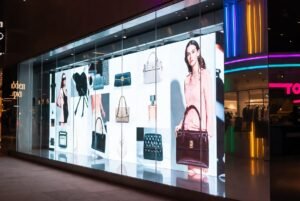
The choice between Holographic Fan Arrays and Transparent LED Displays is not merely a technical one; it is a strategic decision that profoundly impacts customer engagement, brand perception, and ultimately, sales performance. Each technology offers unique advantages, catering to distinct retail objectives – from the captivating, unmissable allure of a floating 3D product demonstration to the elegant, seamless integration of dynamic content within a store’s architectural transparency. By meticulously evaluating your retail environment, specific marketing goals, content strategy, and long-term vision, and by partnering with experienced technical consultants, retailers can confidently invest in these cutting-edge 3D LED solutions. The future of retail is immersive, interactive, and undeniably visual. Embracing these advanced display technologies empowers businesses to not just compete, but to truly captivate and thrive in the experience economy.